How It Works
Suzaku enables liquid staking for Avalanche L1s, allowing your community to participate in securing your network while maintaining capital efficiency through Liquid Staking Tokens (LSTs).
The Dominant Architecture
The most common architecture used by L1s on Suzaku follows this simple model:
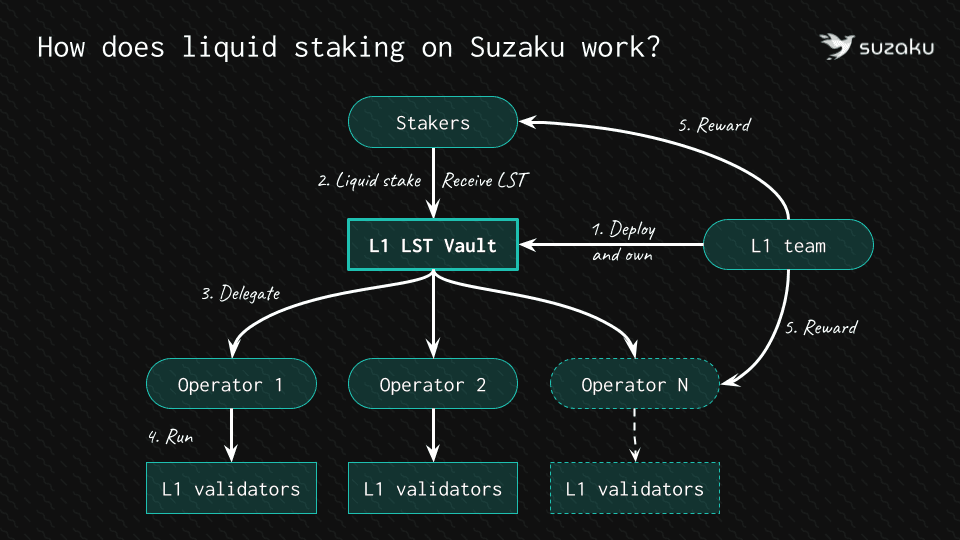
1. Deploy an LST Vault
The L1 team deploys an LST Vault on the Suzaku protocol to enable liquid staking from their community. The L1 team curates the vault with technical support from the Suzaku team.
At a higher maturity stage, the ownership of this Vault can be transferred to the project DAO, and later, the team can let anyone create other LSTs on top of their L1.
2. Community Stakes Native Tokens
Stakers from the community liquid stake their native L1 tokens in the Vault, and receive LST tokens in return (e.g., sPLYR for PLYR tokens, sALOT for ALOT tokens).
These LST tokens can be used across the DeFi ecosystem to earn additional yield while still contributing to the network's security.
3. Vault Delegates to Operators
The Vault delegates staked tokens to different operators. The more operators on the network, the better for effective decentralization.
Operators are high-tier infrastructure providers who run validators for the L1.
4. Operators Run Validators
Operators, in turn, run validators for the L1. The amount of rewards distributed to each operator is adjusted based on the uptime of its validators.
5. L1 Rewards Operators and Stakers
The L1 team rewards both operators and stakers for their contributions to the network.
Rewards include:
- Native L1 token rewards (e.g., PLYR, ALOT)
- Incentives in AVAX
- 2.5x boosted Suzaku points
Rewards and incentives are distributed twice per epoch, based on the performance of the underlying validators.
Key Features
Security
Suzaku-powered L1 LSTs live on the Avalanche C-Chain, which ensures the highest degree of security for staked tokens.
Staking Epochs
Staking epochs for Suzaku-powered LSTs are 7-day long.
After unstaking, a user can withdraw their tokens after a full epoch has passed. This effectively means that it takes between 7 and 14 days for your tokens to be withdrawable, depending on when you initiated the unstake during the current epoch.
Progressive Decentralization
L1s can follow a progressive decentralization approach, starting for example with an initial cap (e.g., 10%) of consensus power allocated to PoS validators in the early phase.
Suzaku is flexible and allows each network to set its own decentralization pace—adapting these parameters as the network matures—so the L1 can gradually increase reliance on PoS and expand the set of operators and validators over time.
Restaking (Optional)
While most L1s start with native token staking only, restaking is available as an optional enhancement to further increase and stabilize cryptoeconomic security.
Restaking allows stakers to use blue-chip tokens (e.g., AVAX LSTs, wrapped BTC, stablecoins) in addition to or instead of the native L1 token. This can be especially useful for TVL-intensive L1s.
Learn more about restaking in the Dual Staking Model section.
Real-World Examples
- sPLYR: PLYR L1's liquid staking token, live now (opens in a new tab)
- sALOT: Dexalot L1's liquid staking token, launching later this quarter
Both follow the architecture described above, with the L1 teams curating their vaults with Suzaku's technical support.