Introduction
Our mission at Suzaku is to help Avalanche blockchain builders:
Plan their decentralization journey
By adapting to their unique needs and goals, with a focus on pragmatism over blind idealism, through our progressive decentralization approach.
Grow their validator set
By connecting them to high-tier specialized operators in order to eliminate single points of failure at the infrastructure layer.
Secure their L1 network
By implementing Proof-of-Stake security, allowing their community to get rewarded for securing the network.
Protocol participants
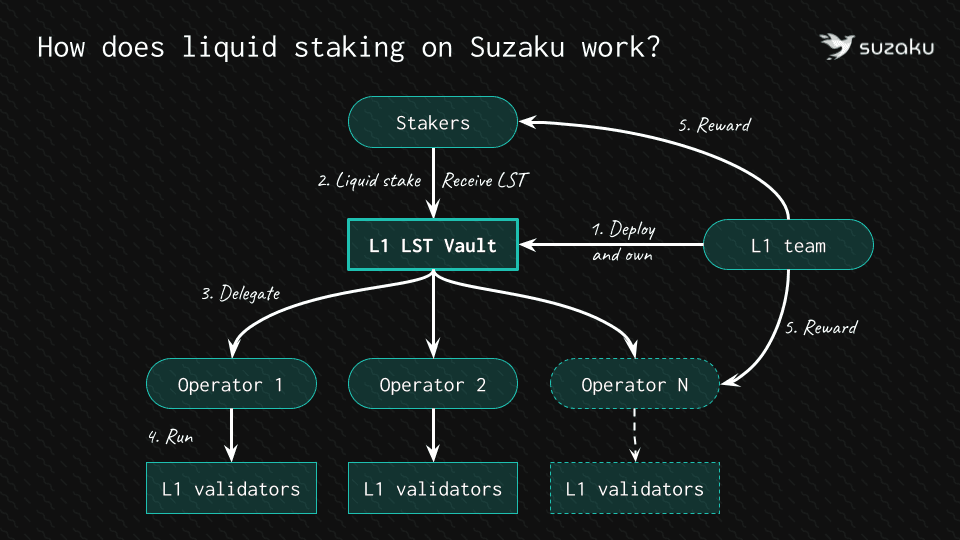
L1 teams
L1 teams deploy and curate an LST vault for their network (with technical support from the Suzaku team). They set the security rules for their network: the staking requirements to spin up validators and the conditions to join as an operator. Suzaku provides reference implementations for the most widely adopted security mechanisms.
Stakers
Community members can stake their L1 native tokens to secure the network and receive LST tokens (Liquid Staking Tokens) in return. These LST tokens can be used across the DeFi ecosystem while still contributing to network security.
Stakers receive rewards from the L1 networks they secure, including:
- Native L1 token rewards
- Incentives in AVAX
- Suzaku points
Restaking (using blue-chip tokens like AVAX LSTs, wrapped BTC, or stablecoins) is available as an optional enhancement for L1s that want to further increase their cryptoeconomic security.
Operators
Operators are responsible for running the infrastructure for Avalanche L1s. They register on Suzaku to provide their services to networks of their choosing.
Avalanche L1s secured by Suzaku are very easy to operate (especially compared to their counterparts in other restaking marketplaces) thanks to the Avalanche L1 stack and open-source tooling available in the ecosystem, (e.g. the Ash Toolkit (opens in a new tab)).