Progressive Decentralization
The Suzaku Protocol enables Avalanche L1s to progressively decentralize their validator set.
This model allows L1s to:
- Launch with a Proof-of-Authority (PoA) model. The list of validators is controlled by the L1 team. They are operating the nodes themselves or delegate this to a trusted group of Operators.
- Switch to a an hybrid model (see BalancerValidatorManager), by splitting the network weight in two: PoA and permissionless Proof-of-Stake (PoS) / Dual staking, enabling permissionless Operators to validate the network.
- Gradually increase the total weight of the permissionless validator set as the L1 matures.
- Reach full decentralization and remove the Proof-of-Authority validator set.
Lifecyle of an Avalanche L1 decentralized with Suzaku
Let's take the example of an Avalanche L1 that wants to progressively decentralize using Suzaku.
Phase 1: Launch
A new Avalanche L1 launches on mainnet with their native asset, $TOKEN, used as the gas token. The L1 has 5 validator nodes, operated by the L1 team. At this point, there is no concept of staking the native $TOKEN, the L1 is Proof-of-Authority (PoA).
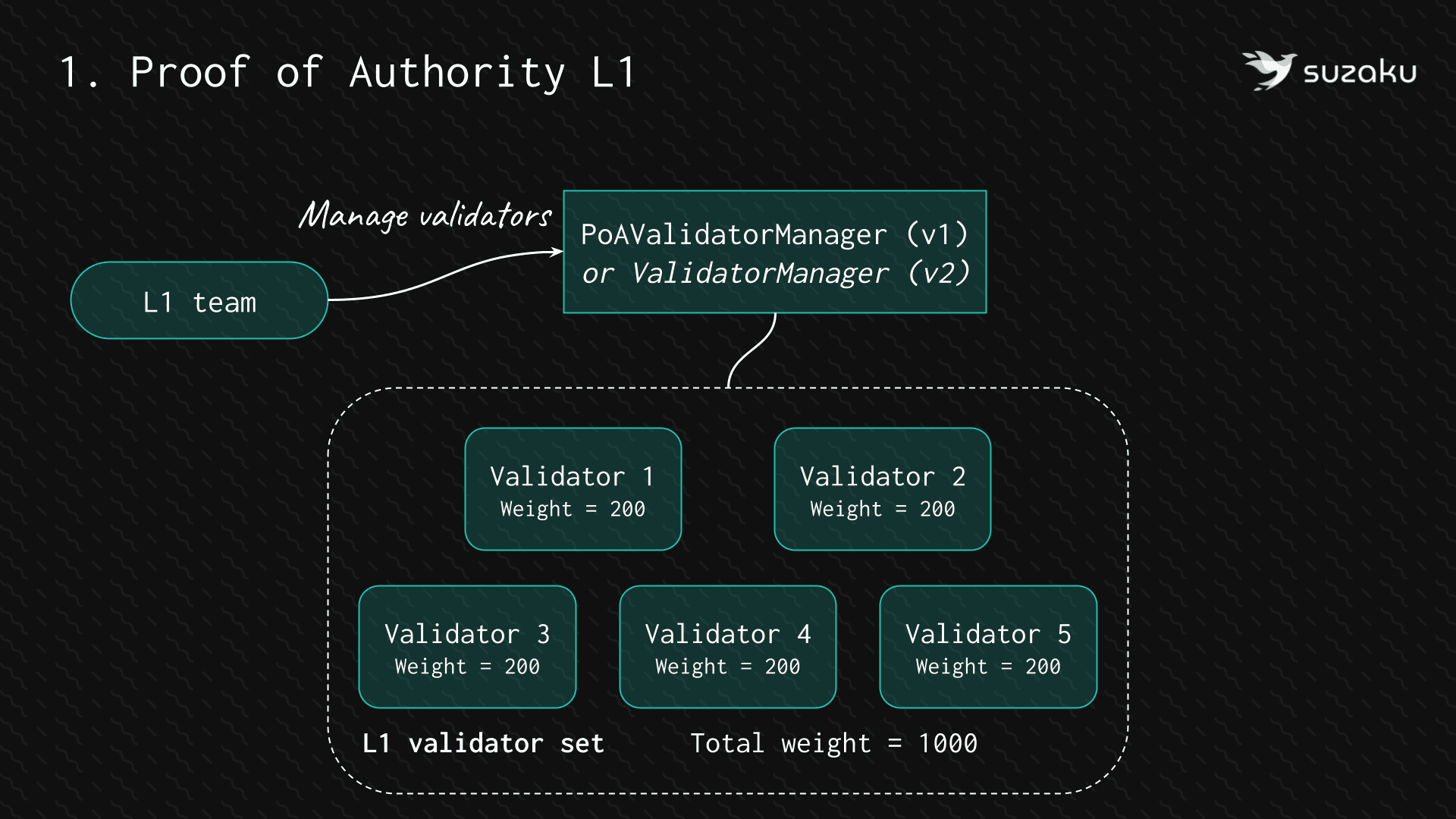
During phase 1, the L1 is only using the
PoAValidatorManager (opens in a new tab)
smart contract to manage the validator set.
Phase 2: Open the L1 validation to permissionless Operators
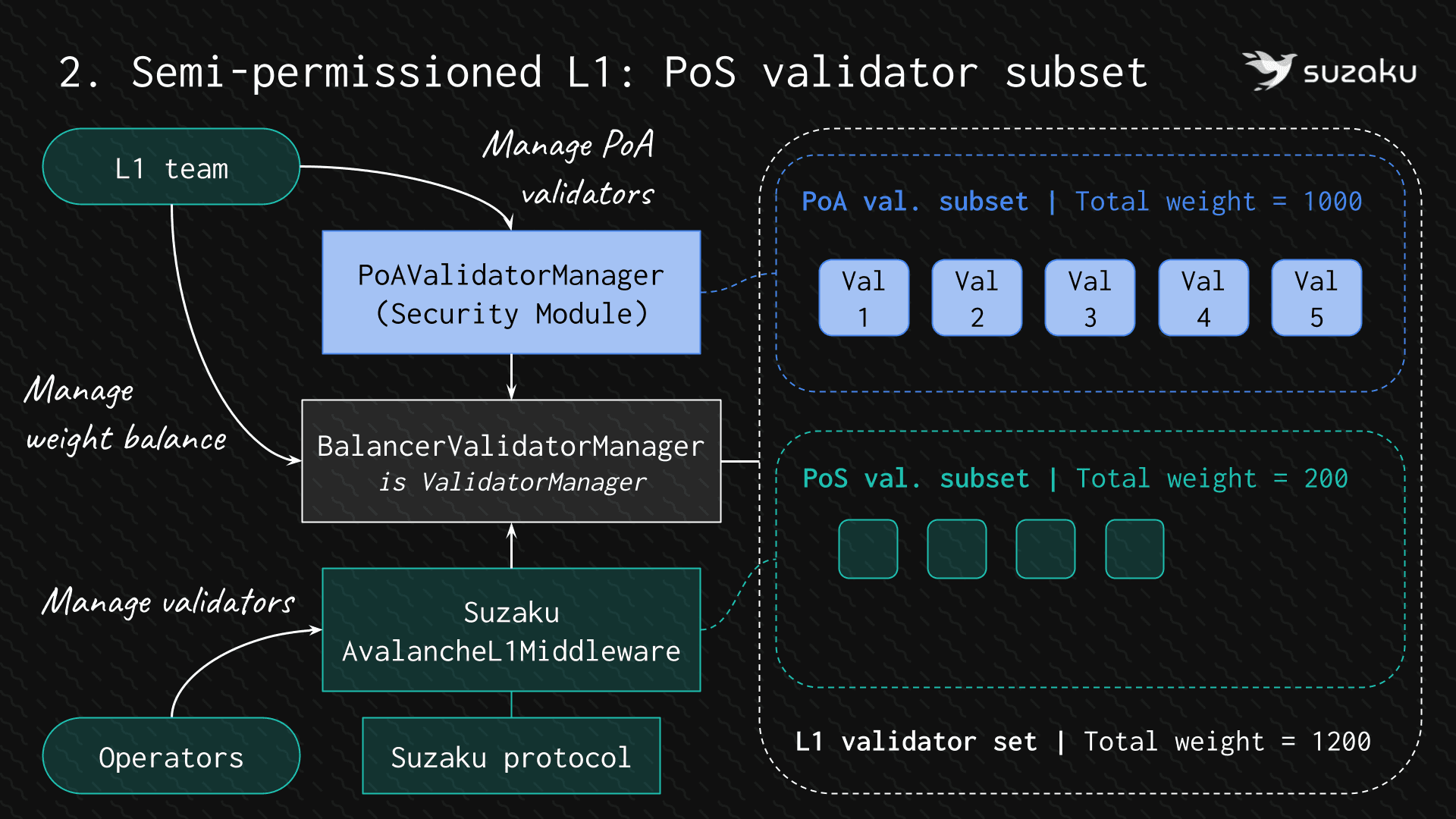
The L1 team upgrades the Validator Manager to a BalancerValidatorManager that manages a PoA validator set and a permissionless validator set through 2 "security modules".
They decide to open 20% of the L1 total weight to permissionless validators, keeping the other 80% for the PoA validator set that they still manage.
The permissionless validator set is managed through the Suzaku AvalancheL1Middleware contract, allowing the L1 to set up staking requirements for permissionless validators. Most L1s start with native token staking only, with restaking as an optional enhancement.
Phase 3: Increase permissionless weight
The L1 team progressively increases the total weight of the permissionless validator set to 80% of the total weight. This can be done at their own pace, and at any time they want, according to the maturity of the L1.
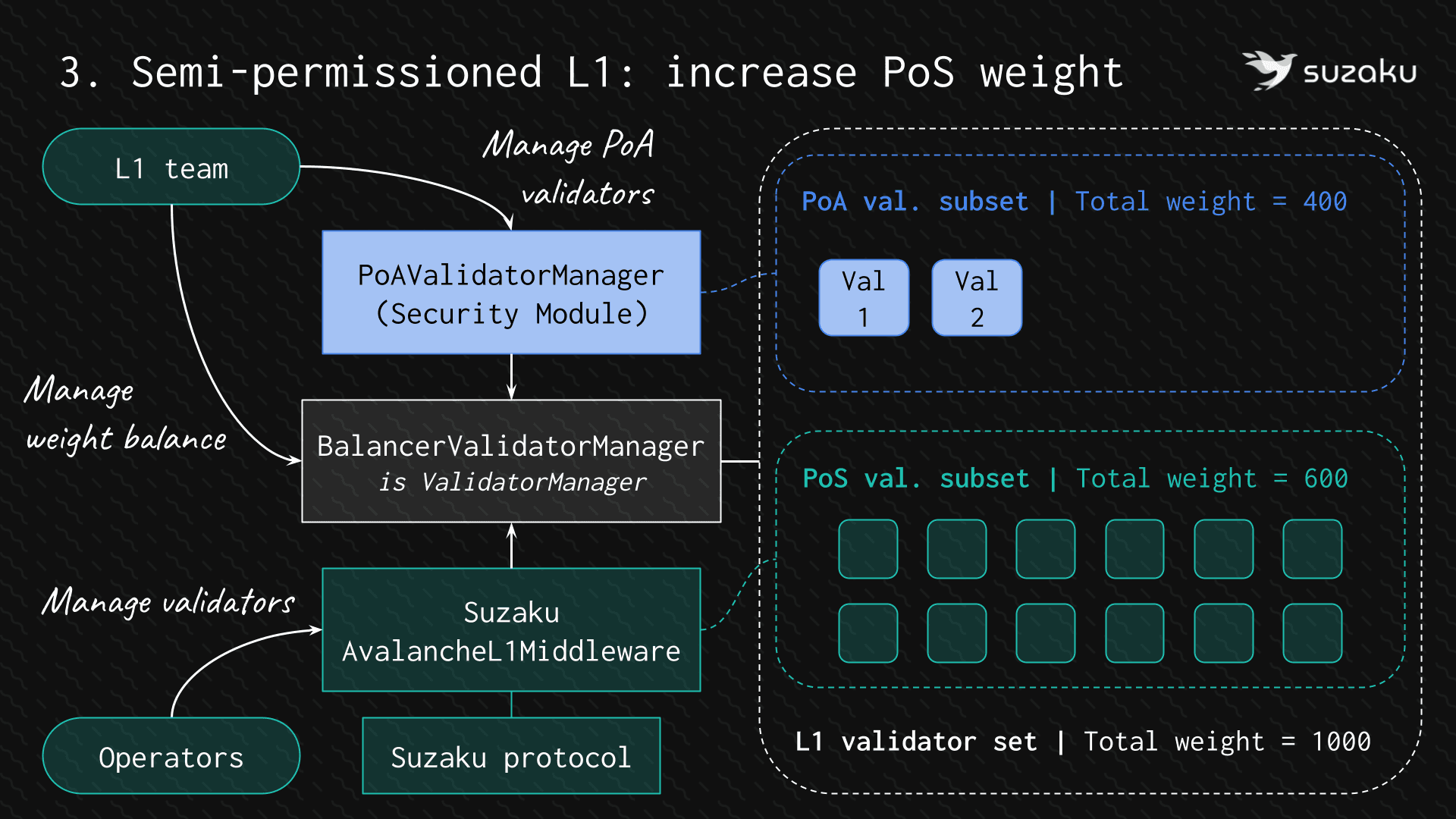
At any point, the L1 team can also decide to change the Dual staking requirements, see Dual staking model.
Phase 4: Make the L1 100% permissionless
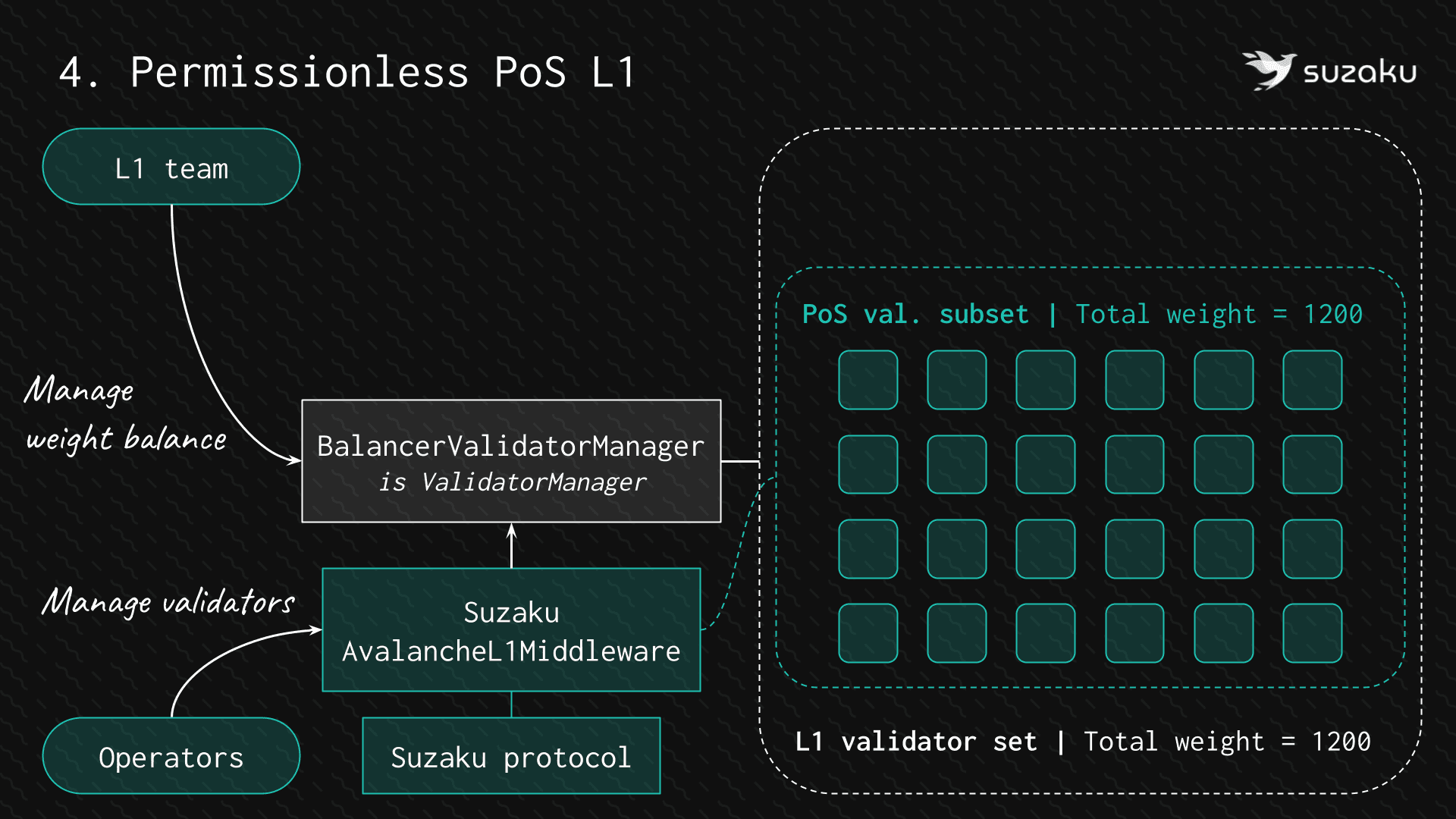
Once the L1 team is confident with the maturity of the L1 and the good distribution of the stake and validator set, they move on to make the L1 100% permissionless by setting the weight managed by the PoAValidatorManager to 0. Effectively turning the L1 into a Proof-of-Stake (PoS) L1.
Balancer Validator Manager
BalancerValidatorManager (opens in a new tab) is a ACP-99 (opens in a new tab)-compliant smart contract that can be used to manage the validator set of Avalanche L1s.
By allowing to balance the weight of an L1 between multiple security modules, the BalancerValidatorManager is a core component of the progressive decentralization model enabled by the Suzaku Protocol.
These security modules can be any smart contract implementing the ISecurityModule (opens in a new tab) interface. The most common setup uses:
PoASecurityModule(opens in a new tab): A Proof-of-Authority validator module for the L1 team to manage the initial validator set.AvalancheL1Middleware(opens in a new tab): Manages Operator registration, Vault registration, stake accounting, and slashing for Avalanche L1s in the Suzaku Protocol (for permissionless validators).
See Protocol Specifications for more technical details.