Dual Staking Model
Restaking is optional. L1s can enable restaking from the beginning or add it at any time as an enhancement to increase and stabilize cryptoeconomic security.
The Suzaku Protocol allows Avalanche L1s to implement a dual staking model for validator nodes, requiring Operators to:
- Stake the L1 native token
- (Re)stake a whitelisted collateral
Important: The weight of each validator is determined only by the native token stake. The restaked collateral acts as an additional requirement to join the network, providing extra security but not contributing to validator weight.
When is Dual Staking Useful?
Dual staking (restaking) is an optional feature that can be useful for L1s in specific situations. L1s can enable restaking from the beginning or add it at any point during their lifecycle.
Launching a new Proof-of-Stake L1 is hard. To launch and decentralize its chain, the L1 developer must:
- Ensure the L1 is secure enough to protect bridged assets
- Incentivize stakers (and delegators) to buy the L1 token and stake it with validators
Cryptoeconomic security problematics
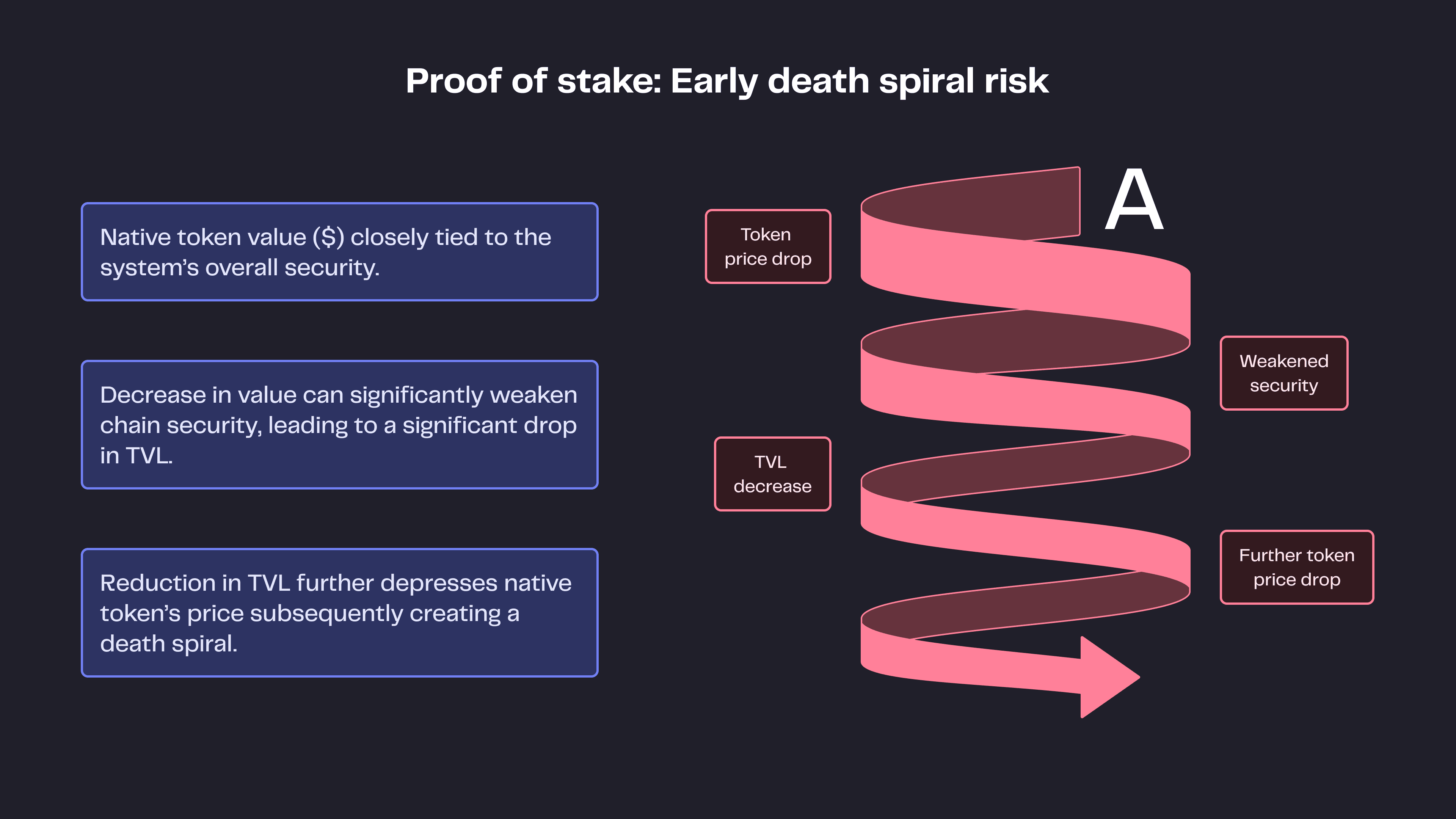
If only relying on its native token for security, an L1 is subject to the early death spiral risk:
- L1 token price drops → security weakens
- Users panic and leave the chain → TVL drops
- L1 token price drops lower, etc.
Staker incentives problematics
The L1 native token, often an new and volatile market asset can be a risk for holders. As a result, a new L1 must offer high APY rates to attract stakers, often in the range of 15-20%, which leads to high selling pressure.
In a "dual-staking" security setup, the L1 team can complement its native L1 token with a blue-chip restaked token in its validator requirements.
Blue-chip token holders secure multiple L1s simultaneously, allowing lower APYs per L1, e.g. 1-1.5%.
To elaborate on that: AVAX liquid-stakers earn 5.5-7% APY, increasing this yield by 4-6% is already significant for them.
How does Dual Staking work in Suzaku?
L1s that want to enable restaking use the AvalancheL1Middleware contract (see Progressive Decentralization).
This smart contract allows the L1 team to:
- Define a Primary Asset (the L1 native token) and its minimum and maximum stake required per validator
- The validator weight is determined solely by the amount of primary asset (native token) staked
- (Optionally) Define a Secondary Asset (e.g. a whitelisted collateral such as $sAVAX) and its minimum stake required per validator
- Secondary assets act as an additional requirement to join the network but do not contribute to validator weight
- (Optionally) Define more Secondary Assets and their minimum stake required
If secondary assets are defined, an Operator must stake at least the minimum amount of each secondary asset in addition to the primary asset to become a validator of the L1. However, only the primary asset stake determines the validator's weight in the network.
If more than one secondary asset is defined, an Operator has to stake the minimum amount of each secondary asset to become a validator.
How to choose the Secondary Asset?
Liquid staking tokens (LSTs) (e.g. $sAVAX or $stAVAX) are a good fit for most L1s since their stakers are already familiar with the concept of staking and are already earning rewards. Using an LST as a secondary asset effectively implements restaking as a security model for the L1.
Stablecoins (e.g. $USDC) are a good fit for L1s that want a very stable cryptoeconomic security, uncorrelated from the cryptocurrency market movements.
Bitcoin-aligned L1s can use wrapped Bitcoin (e.g. $BTC.b) as a secondary asset. Bitcoin has 2 great properties: its holders have low requirements in terms of APY, and it is less volatile than other cryptocurrencies while still reflecting the overall market movements.